
Progress in lung ultrasound education: An updated systematic review
Keywords:
Thoracic ultrasound, Pulmonary ultrasound, Point-of-care ultrasound, medical education, training, clinical skillsAbstract
Background: Thoracic ultrasound (TUS) is integrated into clinical practice across various medical specialties to aid with diagnosis and procedural safety. Significant variability in training approaches and standards exists between nations and individual centres.
Aim and objectives: To review how differences in published TUS training methods impact upon learning.
Methods: A literature search following PRISMA guidelines was conducted in Medline, Embase, Cochrane Library and Scopus, from Jan 2017 until May 2025. Studies involving TUS education using pre- and post-assessments of learning were included.
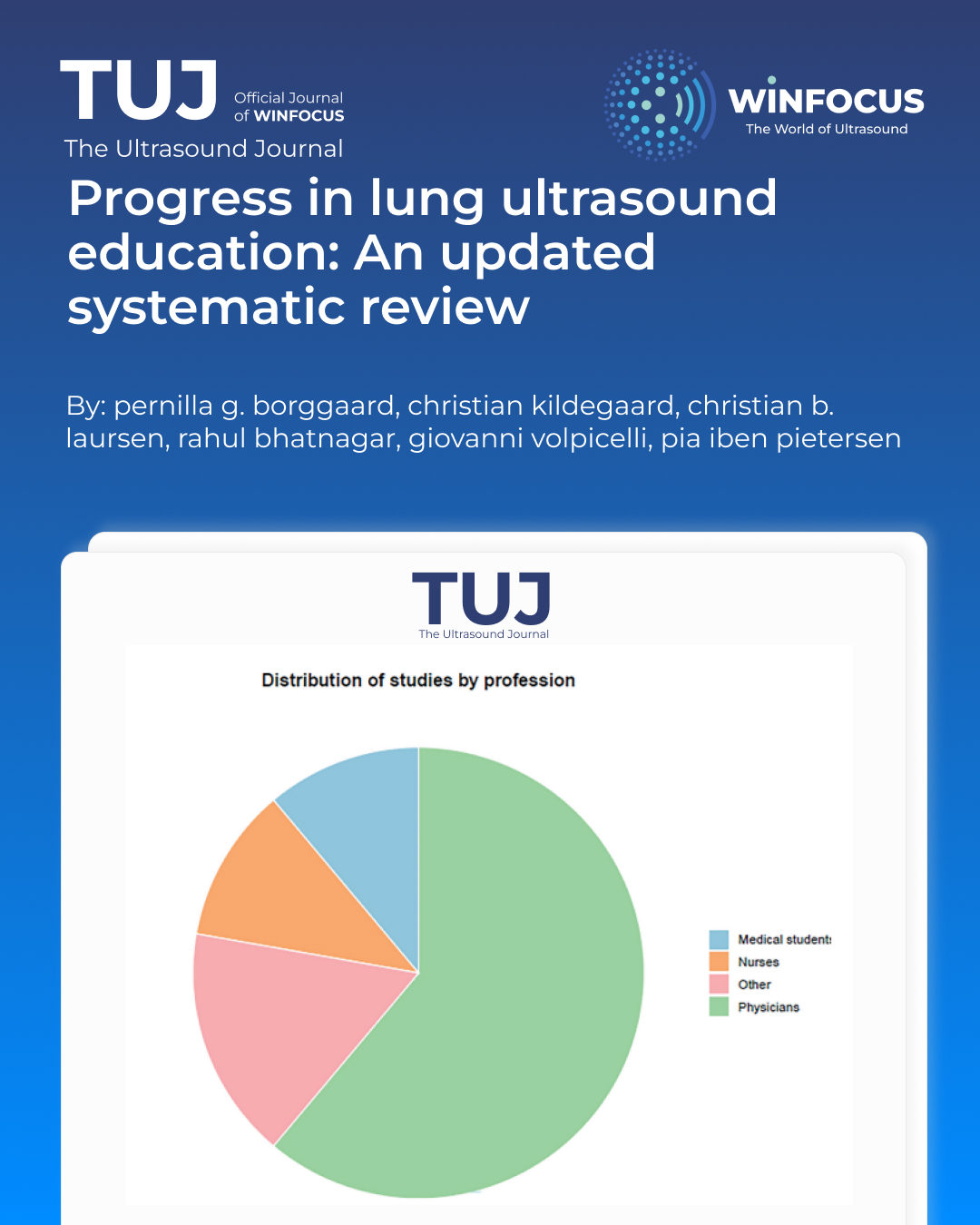
Results: 12,460 studies were screened, 235 full texts assessed, and 68 were included in the review. Studies were mainly observational cohorts targeting different healthcare professionals. Ten randomized controlled trials, four non-randomized comparison and one switching replications evaluating different interventions were identified. Physicians were the primary audience in 65% while 29% focused on other healthcare professionals. Class-based teaching was the most common educational tool (66%) sometimes combined with web-based (16%). 84% of studies involved practical training, with training on humans alone (in 63% of cases). Most educational tools led to significant improvements in test scores, although assessment validity was rarely addressed.
Conclusion: Our review confirms various TUS educational methods are used in heterogenous participants. While most interventions demonstrated positive learning effects, few studies addressed how this translates to safe clinical use.
References
1. Laursen CB, Via G, Basille D, Bhatnagar R, Jenssen C, Konge L, et al. Professional Standards in Thoracic Ultrasound - EFSUMB Position Paper. Ultraschall Med. 2025. Epub 20250916. doi: 10.1055/a-2702-5310. PubMed PMID: 40957610.
2. Thoracic Ultrasound. Laursen CB, Rahman NM, Volpicelli G, editors2018. 266 p.
3. Blehar DJ, Barton B, Gaspari RJ. Learning curves in emergency ultrasound education. Acad Emerg Med. 2015;22(5):574-82. Epub 20150422. doi: 10.1111/acem.12653. PubMed PMID: 25903780.
4. Laursen CB, Clive A, Hallifax R, Pietersen PI, Asciak R, Davidsen JR, et al. European Respiratory Society statement on thoracic ultrasound. Eur Respir J. 2021;57(3). Epub 20210304. doi: 10.1183/13993003.01519-2020. PubMed PMID: 33033148.
5. Mongodi S, Bonomi F, Vaschetto R, Robba C, Salve G, Volta CA, et al. Point-of-care ultrasound training for residents in anaesthesia and critical care: results of a national survey comparing residents and training program directors' perspectives. BMC Med Educ. 2022;22(1):647. Epub 20220828. doi: 10.1186/s12909-022-03708-w. PubMed PMID: 36031630; PubMed Central PMCID: PMC9420188.
6. Olgers TJ, Ter Maaten JC. Point-of-care ultrasound curriculum for internal medicine residents: what do you desire? A national survey. BMC Med Educ. 2020;20(1):30. Epub 20200131. doi: 10.1186/s12909-020-1949-4. PubMed PMID: 32005231; PubMed Central PMCID: PMC6995217.
7. de Boer WS, Veldman C, Parlevliet KL, van Geffen WH, Edens MA, Stigt JA, et al. The current state of ultrasound training in pulmonary residency programmes in the Netherlands: an educational review. Breathe (Sheff). 2025;21(3):250099. Epub 20250916. doi: 10.1183/20734735.0099-2025. PubMed PMID: 40964180; PubMed Central PMCID: PMC12439305.
8. Pietersen PI, Madsen KR, Graumann O, Konge L, Nielsen BU, Laursen CB. Lung ultrasound training: a systematic review of published literature in clinical lung ultrasound training. Crit Ultrasound J. 2018;10(1):23. Epub 20180903. doi: 10.1186/s13089-018-0103-6. PubMed PMID: 30175392; PubMed Central PMCID: PMC6119680.
9. Moher D, Liberati A, Tetzlaff J, Altman DG. Preferred reporting items for systematic reviews and meta-analyses: the PRISMA statement. Int J Surg. 2010;8(5):336-41. Epub 20100218. doi: 10.1016/j.ijsu.2010.02.007. PubMed PMID: 20171303.
10. Kirkpatrick DL. The Four Levels of Evaluation. In: Brown SM, Seidner CJ, editors. Evaluating Corporate Training: Models and Issues. Dordrecht: Springer Netherlands; 1998. p. 95-112.
11. Greenstein YY, Littauer R, Narasimhan M, Mayo PH, Koenig SJ. Effectiveness of a Critical Care Ultrasonography Course. Chest. 2017;151(1):34-40. doi: https://dx.doi.org/10.1016/j.chest.2016.08.1465. PubMed PMID: 614112394.
12. Edrich T, Stopfkuchen-Evans M, Scheiermann P, Heim M, Chan W, Stone MB, et al. A Comparison of Web-Based with Traditional Classroom-Based Training of Lung Ultrasound for the Exclusion of Pneumothorax. 2016;123(1):123‐8. doi: 10.1213/ANE.0000000000001383. PubMed PMID: CN-01382845.
13. Haskins SC, Feldman D, Fields KG, Kirksey MA, Lien CA, Luu TH, et al. Teaching a Point-of-Care Ultrasound Curriculum to Anesthesiology Trainees With Traditional Didactic Lectures or an Online E-Learning Platform: A Pilot Study. The journal of education in perioperative medicine : JEPM. 2018;20(3):E624.
14. Kumar A, Weng Y, Wang L, Bentley J, Almli M, Hom J, et al. Portable ultrasound device usage and learning outcomes among internal medicine trainees: A parallel-group randomized trial. Journal of Hospital Medicine. 2020;15(3):154-9. doi: https://dx.doi.org/10.12788//jhm.3351. PubMed PMID: 2006097496.
15. Matthews L, Contino K, Nussbaum C, Hunter K, Schorr C, Puri N. Skill retention with ultrasound curricula. PLoS ONE. 2020;15(12 December):e0243086. doi: https://dx.doi.org/10.1371/journal.pone.0243086. PubMed PMID: 2010307525.
16. Soon AW, Toney AG, Stidham T, Kendall J, Roosevelt G. Teaching Point-of-Care Lung Ultrasound to Novice Pediatric Learners: Web-Based E-Learning Versus Traditional Classroom Didactic. Pediatric Emergency Care. 2020;36(7):317-21. doi: https://dx.doi.org/10.1097/PEC.0000000000001482. PubMed PMID: 633531828.
17. Wang J, Zhao R, Chiem A. 377 Peer-Instructed Teleguidance Ultrasound in Undergraduate Medical Education: A Randomized Control Equivalence Study. Annals of Emergency Medicine. 2022;80(4 Supplement):S163. doi: https://dx.doi.org/10.1016/j.annemergmed.2022.08.404. PubMed PMID: 2020428995.
18. Höhne E, Bauer E, Bauer C, Schäfer V, Gotta J, Reschke P, et al. A Comparative Bicentric Study on Ultrasound Education for Students: App- and AI-Supported Learning Versus Traditional Hands-on Instruction (AI-Teach Study). Acad Radiol. 2025;32(8):4930-8. Epub 20250428. doi: 10.1016/j.acra.2025.04.024. PubMed PMID: 40300993.
19. Kelm DJ, Ratelle JT, Azeem N, Bonnes SL, Halvorsen AJ, Oxentenko AS, et al. Longitudinal Ultrasound Curriculum Improves Long-Term Retention Among Internal Medicine Residents. J Grad Med Educ. 2015;7(3):454-7. doi: 10.4300/jgme-14-00284.1. PubMed PMID: 26457155; PubMed Central PMCID: PMC4597960.
20. Leidi A, Krauer J, Soret G, Parent T, Marti C, Meyer P, et al. Heart and lung point-of-care ultrasonography tutoring in internal medicine: a randomized controlled trial. J Ultrasound. 2025;28(1):1-9. Epub 20241203. doi: 10.1007/s40477-024-00968-8. PubMed PMID: 39625592; PubMed Central PMCID: PMC11947348.
21. Pietersen PI, Jørgensen R, Graumann O, Konge L, Skaarup SH, Lawaetz Schultz HH, et al. Training Thoracic Ultrasound Skills: A Randomized Controlled Trial of Simulation-Based Training versus Training on Healthy Volunteers. Respiration. 2021;100(1):34-43. Epub 20210115. doi: 10.1159/000509298. PubMed PMID: 33454705.
22. Jedwab R, Boas S, Potashner D, Ostrovsky D, Wacht O, Taragin BH, et al. A Comparison of Online Self-Training and Standard Bedside Training in Lung Ultrasonography for Medical Students. Academic medicine : journal of the Association of American Medical Colleges. 2024;99(3):304-9. doi: https://dx.doi.org/10.1097/ACM.0000000000005462. PubMed PMID: 642442167.
23. Beaulieu Y, Laprise R, Drolet P, Thivierge RL, Serri K, Albert M, et al. Bedside ultrasound training using web-based e-learning and simulation early in the curriculum of residents. Crit Ultrasound J. 2015;7:1. Epub 20150121. doi: 10.1186/s13089-014-0018-9. PubMed PMID: 25852842; PubMed Central PMCID: PMC4384705.
24. Weimer JM, Widmer N, Strelow K-U, Hopf P, Buggenhagen H, Dirks K, et al. Long-Term Effectiveness and Sustainability of Integrating Peer-Assisted Ultrasound Courses into Medical School—A Prospective Study. Tomography. 2023;9(4):1315-28. PubMed PMID: doi:10.3390/tomography9040104.
25. Shi D, Liu J, Xu J, Zhu H, Yu X. Evaluation of a new goal-directed training curriculum for point-of-care ultrasound in the emergency department: impact on physician self-confidence and ultrasound skills. European Journal of Trauma and Emergency Surgery. 2021;47(2):435-44. doi: 10.1007/s00068-019-01126-0.
26. Vafaei A, Heidari K, Hosseini MA, Alavi-Moghaddam M. Role of feedback during evaluation in improving emergencymedicine residents' skills; an experimental study. Archives of Academic Emergency Medicine. 2019;7(1). PubMed PMID: 631236493.
27. Rappaport C, Schwartz A, McConomy B, Choice S, Ten Eyck P, Smock J. Implementing a 3 year, longitudinal point of care ultrasound curriculum in an internal medicine residency program. Journal of Ultrasound. 2024;27(1):123-7. doi: https://dx.doi.org/10.1007/s40477-023-00838-9. PubMed PMID: 2026639651.
28. Wang H, Uraco AM, Stover J, Hollis N. Novel 4W (When-Where-What-What) Approach of Training Point-of-Care Ultrasound (POCUS) Application in Resuscitation With High-Fidelity Simulator. Cureus. 2020;12(7):e9353. doi: https://dx.doi.org/10.7759/cureus.9353.
29. Buhumaid R, Kilian P, Zidan MA, Salman H, AlSharhan R, Khansaheb H, et al. From novice to proficient: a longitudinal study of POCUS skill development through a hybrid certification program in the United Arab Emirates. BMC Med Educ. 2025;25(1):568. Epub 20250417. doi: 10.1186/s12909-025-07138-2. PubMed PMID: 40247259; PubMed Central PMCID: PMC12007165.
30. Patel K, Fox TH, Olejniczak M, Yesbeck L, Ritchie A, Sadrinia C, et al. Effect of Lung Ultrasound Didactics on Trainees' Interpretation of Lung Sonograms. A39 EDUCATING THE EDUCATORS: ADVANCES IN CRITICAL CARE MEDICAL EDUCATION. p. A1505-A.
31. Grubic N, Belliveau DJ, Herr JE, Nihal S, Wong SWS, Lam J, et al. Training of Non-expert Users Using Remotely Delivered, Point-of-Care Tele-Ultrasound: A Proof-of-Concept Study in 2 Canadian Communities. Ultrasound Quarterly. 2023;39(3):118-23. doi: https://dx.doi.org/10.1097/RUQ.0000000000000622. PubMed PMID: 2027073689.
32. Herrera PM, Blair PW, Siddharthan T, Fong T, Pollett S, Clark DV. Implementation of an International Severe Infection Point-of-Care Ultrasound Research Network. Military medicine. 2023((Herrera, Siddharthan) Division of Pulmonary, Critical Care and Sleep Medicine, University of Miami, Miami FL 33136, United States(Blair, Pollett, Clark) Henry M. Jackson Foundation for the Advancement of Military Medicine, Inc., Bethesda, United States(B). doi: https://dx.doi.org/10.1093/milmed/usad393. PubMed PMID: 642501920.
33. Lum M, Sheehy L, Lai J, Tillman D, Damewood S, Schmidt J. Integration of lung point-of-care ultrasound into clinical decision making for medical students in simulated cases. Western Journal of Emergency Medicine. 2021;22(1):124-9. doi: https://dx.doi.org/10.5811/WESTJEM.2020.12.48717. PubMed PMID: 2011095317.
34. Tivendale L, El-Ansary D, Royse A, Royse C, Canty D. Multimodal Lung and Sternal Ultrasound Education Program for Cardiothoracic Nurses and Physiotherapists. Heart Lung and Circulation. 2021;30(Supplement 3):S98. doi: https://dx.doi.org/10.1016/j.hlc.2021.06.021. PubMed PMID: 2013824785.
35. Vallangca G, Kim J, Farrar K, Altmeyer L, Ogle K, Boniface K, et al. STRUCTURED POINT-OF-CARE ULTRASOUND TRAINING FOR CRITICAL CARE ADVANCED PRACTICE PROVIDERS. Critical Care Medicine. 2023;51(1 Supplement):494. doi: https://dx.doi.org/10.1097/01.ccm.0000909736.80125.0b. PubMed PMID: 640006098.
36. Parker E, Totura W, Majewski M, Mukherji J, Tetteh E, Byram S. Developing a Roadmap for a Competency-Based Point-of-Care Ultrasound Education Program. J Educ Perioper Med. 2025;27(1):E741. Epub 20250408. doi: 10.46374/VolXXVII_Issue1_Parker. PubMed PMID: 40207080; PubMed Central PMCID: PMC11978225.
37. Resop DM, Basrai Z, Boyd JS, Williams JP, Nathanson R, Mader MJ, et al. Current use, training, and barriers in point-of-care ultrasound in emergency departments in 2020: A National Survey of VA hospitals. Am J Emerg Med. 2023;63:142-6. Epub 20220916. doi: 10.1016/j.ajem.2022.09.019. PubMed PMID: 36182580.
38. Mongodi S, Arioli R, Quaini A, Grugnetti G, Grugnetti AM, Mojoli F. Lung ultrasound training: how short is too short? observational study on the effects of a focused theoretical training for novice learners. BMC medical education. 2024;24(1):166. doi: https://dx.doi.org/10.1186/s12909-024-05148-0. PubMed PMID: 643558302.
39. Mousa A, Plantinga C, Blok SG, Den Boer S, Cox LAE, Scholten H, et al. Effectiveness of Lung Ultrasound training in intensive care unit staff (TRAINER). A prospective multicenter observational cohort study. Intensive Care Medicine Experimental. 2023;11(Supplement 1). doi: https://dx.doi.org/10.1186/s40635-023-00546-y. PubMed PMID: 642885683.
40. McGaghie WC. Mastery learning: it is time for medical education to join the 21st century. Acad Med. 2015;90(11):1438-41. doi: 10.1097/acm.0000000000000911. PubMed PMID: 26375269.
41. Downing SM, Yudkowsky R. Assessment in Health Professions Education: Routledge; 2009.
42. Laursen CB, Via G, Basille D, Bhatnagar R, Jenssen C, Konge L, et al. Thoracic Ultrasound - EFSUMB Training Recommendations - a Position Paper. Ultraschall Med. 2025. Epub 20251006. doi: 10.1055/a-2664-6541. PubMed PMID: 40701630.
43. Skaarup SH, Laursen CB, Bjerrum AS, Hilberg O. Objective and Structured Assessment of Lung Ultrasound Competence. A Multispecialty Delphi Consensus and Construct Validity Study. Ann Am Thorac Soc. 2017;14(4):555-60. doi: 10.1513/AnnalsATS.201611-894OC. PubMed PMID: 28145770.
44. Pietersen PI, Konge L, Madsen KR, Bendixen M, Maskell NA, Rahman N, et al. Development of and Gathering Validity Evidence for a Theoretical Test in Thoracic Ultrasound. Respiration. 2019;98(3):221-9. Epub 20190528. doi: 10.1159/000500146. PubMed PMID: 31137031.
45. Challa KT, Sayed A, Acharya Y. Modern techniques of teaching and learning in medical education: a descriptive literature review. MedEdPublish (2016). 2021;10:18. Epub 20210121. doi: 10.15694/mep.2021.000018.1. PubMed PMID: 38486533; PubMed Central PMCID: PMC10939590.
46. Yudkowsky R, Park YS, Lineberry M, Knox A, Ritter EM. Setting mastery learning standards. Acad Med. 2015;90(11):1495-500. doi: 10.1097/acm.0000000000000887. PubMed PMID: 26375263.
47. Ten Cate O, Schumacher DJ. Entrustable professional activities versus competencies and skills: Exploring why different concepts are often conflated. Adv Health Sci Educ Theory Pract. 2022;27(2):491-9. Epub 20220228. doi: 10.1007/s10459-022-10098-7. PubMed PMID: 35226240; PubMed Central PMCID: PMC9117349.
Downloads
Additional Files
Published
Issue
Section
License
Copyright (c) 2026 Pernilla G. Borggaard, Christian Kildegaard, Christian B. Laursen, Rahul Bhatnagar, Giovanni Volpicelli, Pia Iben Pietersen (Author)

This work is licensed under a Creative Commons Attribution-NonCommercial 4.0 International License.
This is an Open Access article distributed under the terms of the Creative Commons Attribution License (https://creativecommons.org/licenses/by-nc/4.0) which permits unrestricted use, distribution, and reproduction in any medium, provided the original work is properly cited.
Authors retain the copyright for their published work. No formal permission will be required to reproduce parts (tables or illustrations) of published papers, provided the source is quoted appropriately and reproduction has no commercial intent.
How to Cite


